Tuesday

Soft knees

Many people make two mistakes with sinking and rooting - they bend the knees too deep or they keep the knees too straight.
This can lead to knee injury.

Keep the physical 'doing' to a minimum:

  1. With the knees naturally soft and relaxed, allow the rest of the body to soften and sink
  2. Sink into the hip joint
  3. It is the hips that sink, not just the knees
  4. The thighs may begin to burn/ache initially
  5. The lower back will straighten of its own accord when your gluteus muscles are working
  6. Think of the tailbone curling under but don't force anything
Avoid any discomfort in the knees; if your knees hurt, they are squatting too low and that is incorrect.

Monday

Body weight

Each movement requires a movement of body weight.
You must become accustomed to moving the weight - not the just limb - when performing an action.
Moving from leg to leg is not enough; you must get your weight behind the movement.

Additionally, it is necessary to distinguish between weighted and unweighted.
With very few exceptions, steps should be unweighted.

Sunday

Lower body

Ensure that the legs are responsible for power.
Imagine that you are pulling or pushing using your waist and legs as a starting point.

Moving your hips will cause the torso to move.

The centre of gravity is in the intestines because they contain the largest volume of water in the body.
When the lower body leads the action, everything else follows.

Saturday

Leg strength

A woman cannot reasonably hope for success when she uses her upper body for strength against a male opponent.
Biology is against you.

You need to think about your lower body, in particular your legs.

When you measure the size of leg muscles relative to arms, you find that the leg muscles are significantly larger and can produce vastly more power.
Connect your arms to your back, and use your legs to drive your movements.


Friday

Know yourself

Much of the tai chi training is about untangling the knots that society has tied us in.
This is a difficult, complicated and often frightening process.
Not everyone wants to know themselves, or cares to probe deep beneath the surface.

Many philosophical traditions have urged people to "Know thyself!"
It is a fundamental precept.
Koan represent an example of how zen seeks to accomplish this goal.
There are many other ways to explore your own consciousness.

The first step in getting to know yourself a little better is simply wanting to.
If you open your mind, you have already started.
Do not dismiss anything, or you will retreat from understanding, and withdraw into the familiar...

Thursday

Female qualities?

The inherent qualities of tai chi are softness, looseness of muscles and joints at all times, unseen strength that does not rely on muscular contraction or brute force, fluid movement in accord with others, optimal use of your own physical body and yielding to force at all times.

Women and men learn the same material, but with a slightly different emphasis. Each gender must be true to their own nature.

Wednesday

No te

It is extremely common for beginners to demonstrate no understanding of te at all.
The most obvious fault is forcing.
Rather than let the reeling silk undulation wave do the work, the student uses brute force.
This may be fine in an external class, but in tai chi it is clumsy.

Only an inexperienced tai chi person uses strength rather than jing.

Jing is akin to the ocean tossing a boulder. The water uses no strength. It just undulates.
The kinetic motion does all the work. This is te.

Tuesday

Power

The power, the virtue of the female is found in being a woman; rather than emulating the characteristics of a man.
Hence, a woman is balanced by being womanly. Masculinity of manner or dress is seen as discordant with the essence of a woman.
The same principle applies to men.

You cannot be other than what you are, and any attempt to change your innate qualities is considered futile.
Taoism sees strength in being true to what you are, in following your own nature.

This is part of wu wei; going with the flow.
Wu wei explores how power can be gained by keeping to the grain rather than going against it.
When travelling in water, it is simpler to be carried along than to fight the current.

In taoism, people seek to take this one step further by asking what they can do to capitalise upon the virtue.
What can they do to improve their harmony with the flow?
In water, it might mean using a sail.
With people, it could be attire or a consideration of posture and speech.
The art of feng shui specialises in this skill.

Monday

£2.50 an hour...

School members who attend both Benton and Heaton classes for the full 2 hours only pay £2.50 an hour.

Being

Self-consciousness prevents people from acting in accord with their own nature, and virtue is lost.
Consider the flamenco dancer:

There must be a total immersion in the event itself.
The divide between the dance and the dancer must cease to exist; they must become one: a joining of femaleness and physical expression.
It is the dancer's femininity and passion that makes the flamenco the flamenco.

Sunday

Is-ness

The appreciation of virtue has long been applied to people.

Dance and fashion make use of virtue constantly.
The femaleness of women is accentuated by costume and poise.
A flamenco dancer represents femininity, passion, elegance and strength.

There is nothing masculine about the expression, body language, voice and mannerisms.
By expressing the characteristics of woman-ness, the dancer is true to her nature.

Saturday

Emotions

Men have long perpetuated the myth that women are more emotional than men.
This is actually entirely untrue: men are culturally conditioned to suppress their emotions and to detach themselves from feeling.
Which is not entirely helpful.

A woman may admit that she feels fear, whereas a man pretends to be brave.
Taoism and zen seek to cultivate emotional awareness, and asks the student to be honest about how they feel.

Friday

Bodies

Men are stronger and heavier above the waist, whilst women are the reverse.
All Asian martial arts seek to encourage students to emulate the female body, and drop the weight down.
This is a logical approach; since a firm base promotes stability.

Tai chi teaches all students to rely upon the strength of the legs and the waist, rather than the arms and shoulders.
Again, this favours women.

Thursday

Differences

 Men and women are different.
This simple fact must be the starting point when teaching tai chi self defence to female students.

Men have testosterone, they enjoy using force, being aggressive and competing with one another. They are usually quite happy being roughed-up and roughing people up in return.
Although only a few of these qualities are of any use in tai chi, it enables men to feel more comfortable working martially than most women do.

Women bring entirely different qualities to tai chi.
These are actually the very values and sensibilities that tai chi seeks to cultivate in the male student.
The challenge for the female student is to harness their strengths, to have faith in themselves and the art, and to overcome their conditioned inhibitions.

Wednesday

Different

In taoism, men and women are seen as uniquely different.

The yin/yang symbol represents the balancing of these differences; the perfect harmony of opposites.
Women are yin and men are yang; each has attributes unique and specific to their own gender.
These were never intended to be clichés or stereotypes; they arose through observation rather than thought.
Yin and yang are equal, yet different to one another.

Tuesday

Patronising

Male students will tend to go easy on female students. It is important not to give men a reason to do this.
Men may treat you with 'kid gloves' or speak to you in a condescending manner.
In our school, we discourage such behaviour.
Many instructors give women a false sense of reassurance. This is offensive and insulting.
Truth is essential.
You cannot hide the fact of your skill. It is either present or lacking. There is no ambiguity to it.

No real life assailant will cut a woman any slack.


Monday

Home life

Not all partners are supportive.
They may feel threatened.
Or they think that its cute for a woman to take up martial arts training.

Partners often tend to belittle or intimidate their wives and girlfriends when they learn that you are taking self defence classes.

Sunday

Gender stereotyping

 Society has presented an image of women as being helpless.
This may have been replaced (to a small extent) in recent years with media stories of rough girls being arrested for fighting, but the overall perception of women remains the same.

When a woman enters a martial arts class, she is taking a brave step into a male-dominated arena.

You will be immediately faced with a whole range of unflattering associations, based purely upon gender.
Many men are reluctant to partner with a woman.
Women are generally considered to make ineffectual assailants.

Saturday

Women in martial arts

Women typically do not fare too well in martial arts classes. Men have all of the natural advantages when it comes to violence:
  1. Aggression
  2. Familiarity with violence
  3. Physical strength
  4. Testosterone
In the external arts, these qualities count for a lot, and women usually flounder.
The schools compensate by having weight and gender categories, or by simply patronising female students.
This may work fine in the dojo, but no one in the street will let a woman off because she lacks their own physical strength.

Friday

Manners


Patterns of manners develop within social groups. 
They are refined over time until they reflect a way of living that is relevant to the society. 

Over the last 50 years in the west, there has been a drive to break down old barriers. 
A “brave new world” of egalitarianism and equality has been created.
This is reflected by the modern form of manners, which tends to be based on political correctness. 
The problem is that political correctness changes depending on the prevailing politics. 
It also tends to be imposed on society, rather than reflecting society.  

In the drive to get rid of behaviours that were seen to be unsuitable for the 20/21st century (e.g. automatic deference to “higher classes”), we have eradicated a lot that made sense and gave life meaning. 
Is it right, or is it sexist, to hold a door open for a woman? 
Should a person be respected because they have been on “reality TV”?

The drive to modernise in the east has not destroyed the need for respect or traditional manners.  
In the east they understand more the value of tradition. 
Behaviour is measured and considered. 
Human interaction is valued, and respect is important. 

In the west we often act without thinking, or with the arrogant assumption that what we do is right, or best. 
The “free-and-easy” approach of the west is often at odds with the more traditional east. 

This is rarely a problem when eastern manners meet western society, as little value is placed on manners in the west. 
A show of good manners may be accepted with awkwardness, condescension or misplaced humour.  

However, problems can arise when western manners meet eastern society
The seemingly gross and unthinking behaviour can show a lack of subtlety and sensitivity. 
Although displeasure will rarely be shown, the westerner may be viewed with disapproval. 

This can be a problem if a westerner wants to get close to anything in the east. 
Why should something be shared if appreciation is not shown in an appropriate way? 

This is, of course, a simplification of the situation. 
Many people in the west have good manners, and are sensitive to the cultures of others. 

Written by Andy Urwin

Thursday

Beyond class

Self defence skills will teach you to approach situations differently; especially at work and in the street.
Instead of responding to aggression with aggression (or fear), you see more
powerful alternatives.

Avoiding
stress is good for your body and your mental health. The training will make you feel calm, confident and capable.

Wednesday

Social events

Social events are important to show that there is more to the class than training once or twice a week. 
They give students the opportunity to meet each other outside of the normal class environment. 
When we’re in the class, we all dress the same and are all focussed on Tai Chi. 


Outside the class each person has a rich and wonderful story to tell. 
By socialising we come to understand the depth that there is to each person in the class. 
Our respect for them grows (if we listen and are open). 

It is also a celebration of what we are studying and achieving together. 

Written by Andy Urwin

Tuesday

Without formal training, the larger and stronger naturally defeat the smaller and weaker. Therefore, a basic premise of training must be that the methods employed should make it possible for the smaller and weaker to defeat the larger and stronger.
(Tim Cartmell)


Monday

Uniform

The uniform puts you in the mood for training, whereas casual clothes will not have the same effect. 
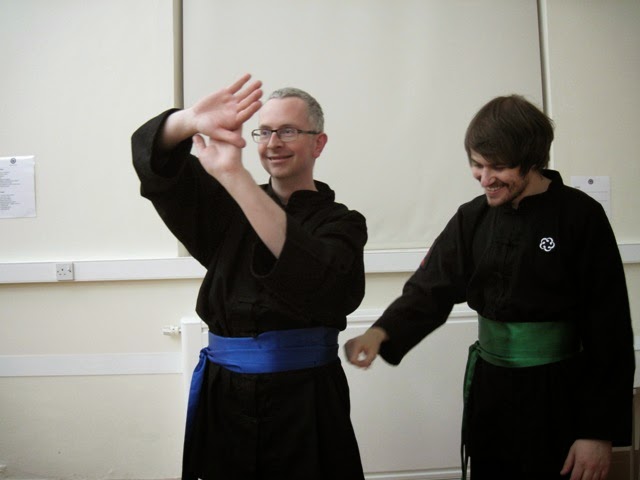
Dressing like a kung fu student encourages you to act like one. 
It ensures a form of discipline and shows that you are taking your training seriously


In practical terms, the uniform was made for tai chi.  It gives the freedom to move as the art requires. 
 
Written by Andy Urwin

Sunday

Fun

Training in our school is fun, friendly and gently challenging.
Many of the skills seem counter-intuitive.
We will invite you to consider new options, possibilities and choices. To drop long-held
preconceptions.

Saturday

Attitude and etiquette

The presence of attitude and etiquette in the school facilitates safety and efficient teaching. 
They give clarity about how to behave and what is expected in the school. 


This clarity allows people to focus on that is being taught and practiced, rather than how to behave. 

If people were not respectful and not paying attention, then the ability to be taught would be compromised. 
If people are not paying attention, then accidents can occur. 
Insensitive behaviour between students can result in someone feeling the need to “get even” or “teach someone a lesson”. 

Without a framework of attitude and etiquette, our safety and ability to be taught would be diminished. 

Written by Andy Urwin

Friday

Realism

Self defence training begins with the fundamentals of effective body use and slowly moves through different levels of threat.
Escaping from holds, evading and
counter-attacking are preliminary concerns.
Eventually you must learn how to handle armed assailants and multiple opponents.

Thursday

Gender

Many martial arts classes separate men and women. They even impose weight categories.
In real life you cannot choose who will
attack you.
In order to cope with a male attacker, women's
self defence must address attacks from both men and women.

Wednesday

Shibashi

I came across a style of tai chi today called 'shibashi' which I'd never heard of. On deeper reading it was apparent that this is not a style of tai chi at all but rather a form of qigong that people are calling tai chi. Confused? So was I.

Apparently many of the teachers gain their experience via DVDs and on-line training courses. Great.

Manners

Manners are a framework of norms that have been developed by a social group. 
They are meant to smooth interactions and reduce misunderstandings between people. 
Different social groups have developed their own framework of manners, based on their situation and their needs. 
This can be a problem when two groups interact, as what is normal for one social group may be insulting to another. 
For example:
-          Sitting with your legs crossed is normal for a westerner. 
It would upset someone from the east, as you are pointing the sole of your foot (very dirty) towards them. 
-          In the UK grief is expressed by the colour black; in China, white. 
-          In the east, flicking the hand backwards and forwards with the fingers pointing downwards means “come here”. 
In the west it means “go away”. 
-          In Japan, “Yes” may mean
                “Yes, I agree with you”,
                “Yes, I have heard what you say, but do not agree with you” or
                “Yes, I will have to go and talk to my boss about this” (and many more possibilities). 
This can be very confusing for westerners. 
Even within a single social group, manners may depend on the situation. 
-          What is acceptable behaviour at a social gathering may not be acceptable in a place of worship. 
-          It may be acceptable to talk while watching a film on the TV at home, but not in a cinema. 
-          Your attitude towards your boss at work may be different to that at your office Christmas party.
Humans interpret their environment based on the “filters” they have built up during their development.
Our manners become “normalised” and even unconscious behaviour. 
We see things as we are. 
Because of this, problems can arise in two ways:
o    Acting in a way that is normal (for us), but is improper or offensive for those from a different background.  
Others can see us as being “rude”. 
o    Misinterpretation or misunderstanding of another groups behaviours, as we do not understand what is going on. 
We can see them as being “rude”.
Initially, some tolerance towards the behaviours of another person or group is beneficial. 
Any slight or transgression of the social norms are probably due to ignorance. 
Over time, however, a person in an alien environment would be expected to learn the social norms of the host group. 
In situations where you are aware that your socialised manners may be at odds with the situation that you are in or the people you are with, it is often best to be careful with your words and gestures, and observe how other people behave.  Ask questions if you are not sure, as people are often happy to answer your questions, as it show that you are taking an interest in them and their culture. 

Written by Andy Urwin


Tuesday

Clarity

The side effects of unpleasant situations are fear and panic. These immobilise the body and prevent clear thinking.
Self defence training encourages composure and mental
clarity.
Instead of feeling vulnerable and exposed, you become integrated and focussed.

Monday

Empowerment

The ability to defend yourself is important in modern society.
There are many ugly situations in which conflict may arise.
Having the confidence and the skills to handle aggression, bullying and violence is invaluable
.

Sunday

Size and strength do not necessarily determine a person's ability to defend themselves - small women have been known to successfully fight off a bigger and stronger attacker. Many women are fitter, brighter and quicker than their male counterparts.
(Barry Davies, SAS)


Saturday

Perspective

When you see a bully for what they really are, you will come to find them embarrassing.
A bully is a weak, insecure person, desperate to feel strong about themselves.
Instead of looking for strength within, they lash out at others and rely upon fear for power.

When you give them humour and pity rather than fear, the bully has no
teeth.
If a bully were genuinely
strong, they would have nothing to prove. They need you to validate them.

Friday

Unwelcome

We do not permit bullies in our classes.
Students are chastened for clumsy/careless/forceful application of the
kung fu.
Any outright bullying will result in an appropriate response and potential banishment from the school.

Bullies are weak people and we only want students of good character.

Thursday

Lineage disciple

Master Waller actively dissuades any student from seeking to become a lineage disciple.
The obligation is not for the half-hearted.

If the student is neglectful with their training and commitments, they will no longer be an indoor student.

Wednesday

Harassment

Harassment is a common form of bullying. It can involve:
  1. Any unwanted persistent sexual advances (physical or verbal)
  2. Racist, sexist, homophobic, insulting remarks, jokes, malicious gossip, banter, innuendo, swearing, name calling
  3. Being excluded from activities
  4. Abuse of power or position
  5. Manipulative questioning: damned if you do/damned if you don't

Tuesday

The effect of bullying

Bullying makes the recipient feel threatened, humiliated and vulnerable.
It may cause them to be de-motivated, suffer
stress-related illness and even resign from work.

The victim feels
disempowered, frustrated, ashamed, embarrassed and helpless.
Often they do not know who to turn to.

Monday

Passive bullying

A passive bully is a very sneaky kind of bully.
They manipulate the recipient by non-confrontational means: feigned vulnerability, emotional displays and mood swings.
Sex can be used as a tool by such people.
Casual flirtation and pretending to be your friend are common methods of passive bullying.

Passive bullies are especially insidious because they project an image of weakness and frailty.
They appear to be the victim but are actually the instigator.

A passive bully will make you feel as though you are letting them down or even letting yourself down.
They are experts at looking harassed, upset and victimised.

Sunday

Family

Families are notoriously guilty of bullying.
They employ a wide variety of devices intended to manipulate the recipient and often involve other family members in the endeavour.

In a marriage/intimate relationship it is very common for the bullying to be an ingrained part of the relationship.
The bullying is so pervasive that the participants no longer see it as such.
They live in a situation of ongoing low-key domestic abuse.

Saturday

Adult bullying

Adult bullying can take many forms:
  1. Verbal, written or physical threat and intimidation
  2. Persistent, negative and unjustified comments
  3. Offensive or abusive personal remarks
  4. Abuse and humiliation in the presence of other colleagues or in private
  5. Removing areas of responsibility without justification and undervaluing work done
  6. Setting the individual unachievable targets and/or changing instructions without consultation in order to cause the individual to fail
  7. Reducing a colleagues effectiveness by withholding important information
  8. Monitoring work unnecessarily and intrusively
  9. Continually refusing reasonable requests without any justification
  10. Unfair allocation of work

Friday

We walk, and our religion is shown (even to the dullest and most insensitive person) in how we walk. Or to put it more accurately, living in this world means choosing, choosing to walk, and the way we choose to walk is infallibly and perfectly expressed in the walk itself. Nothing can disguise it. The walk of an ordinary man and of an enlightened man are as different as that of a snake and a giraffe.
 
(R.H. Blyth)

Thursday

Why do tai chi?

Karen has done something that answers this question.
When she first started class, Karen's arms were suffering from repetitive strain injury. This was the result of her job.
The joints were stiff, immobile and insensitive.

By working closely with Master Waller, being mindful at work and doing tai chi exercises at home, Karen has managed to totally free up her joints, release tension and ease the discomfort.
The positive effects will persist as long as she continues the ongoing treatment.
http://neijiaquan.co.uk/tonic.htm

Karen and Master Waller are now working to release tension in the sacroiliac, lower back and buttocks. Given the success of Karen's work on her arms, they are very optimistic.

Why do tai chi?
To improve the quality of your life.

Tuesday

Tai chi chuan training

Most people don't realise that tai chi started life as a martial art...
150 years ago tai chi chuan was the pinnacle of the Chinese martial arts.
Hard to believe?

Tai chi chuan is only taught to students who join the school:


• Kung fu (combat)
• Self defence
• Weapons
• Qigong (energy work)
• Neigong (whole-body strength)
• Forms
• Pushing hands
• Meditation
• Theory & philosophy
• Chin na (seizing)
• Shuai jiao (take downs)
• Jing
• Form applications
• Kicks, punches, palm strikes
• Finger strikes, elbows, knees
• Accuracy
• Evasive footwork
• Optimal use of alignment
• Minimal movement
• Conservation of energy
• Defence against a knife
• Multiple opponents/gangs
• Joint locks
• Trapping
• Focus
• Stickiness
• Physical sensitivity and awareness
• Balance, rhythm and timing
• Throws
• Escape from holds
• Close-range combat
• Grappling
• Defence whilst on the floor

More than combat

Tai chi chuan is not simply a highly sophisticated, intelligent martial art.
It offers so much more:

• A way to use millennia old Chinese 
wisdom in everyday life   
• 
Meditation 
• An unusual form of 
strength that requires only moderate practice to maintain
• 
Stress-relief 
• Emotional composure in the face of confrontation and crisis 
• The 
release of deeply-held muscular tension    
• 
Philosophical study involving some of the most influential books ever written  
• A NHS endorsed physical therapy suitable for many medical conditions
• Boost 
energy
• Improve balance
• Ease neck, knee, elbow and back problems

Monday

What exactly is bullying?

Bullying happens when one person takes it upon themselves to victimise another.
Typically bullying involves persistent, threatening, abusive, malicious, intimidating and insulting behaviour.
It is intended to undermine the confidence and self-esteem of the recipient.

Particularly serious cases can arise when the bully is perceived to be in a position of power in relation to the person being bullied.
People at birth
are soft and supple;
At death,
they are hard and stiff.

When plants are alive,
they are green and bending;
When they are dead,
they are dry and brittle.

Soft and bending is the way of the living;
Hard and brittle is the way of the dying.
(Lao Tzu)


Sunday

Childhood's end?

Many children are the victims of bullying whilst at school.
As adults we assume that the bullying is over as soon as we leave school and commence work.
Sadly, this is not the case at all.

Bullying occurs in many forms and in many situations.

Saturday

 When asked how he overcame his opponents,
Hadrat Ali explained,
"I never met any man who did not help me against himself."


(Hadrat Ali)

Friday

Skill

A student mentioned to Sifu that he wasn't to confident with his shuai jiao & chin na applications.
He knew the drill but couldn't pull it off effectively or consistently.
http://neijiaquan.co.uk/shuai_jiao__chin_na_application.htm

I have experienced this myself and can tell you that the only solution is 'practice'.
Nothing replaces practice.
Once you've done the same drill hundreds of times it becomes second nature and your skill increases significantly.
You learn better timing, positioning and leverage.

For example: At home Sifu drills the shuai jiao & chin na applications solo in order to improve memory and spatial awareness.
10 per day for 7 days.
He also partners them weekly with me.
This combines 2 effective methods for gaining familiarity: solo & partnered.

Be patient with yourself - the skills will come.
You just need to put in the practice.

Thursday

Confusion about yielding

If taoism is the art of adjusting to life, then tai chi chuan is the art of adjusting to the opponent.
This process of adjustment is what yielding is about.
Balancing, sensitivity, change.

Yielding is concerned with not opposing force, making space... and then counter-attacking.

Having made space, you must incapacitate your attacker. Yielding is only half of the requirement.
Unless you neutralise the attacker, they will continue to assault you.
Step-in decisively and finish-off the attacker.

Wednesday

Internal way

The internal way of using strength has some basic considerations:
  1. Never employ force against force; always yield to strength
  2. No more than 4 ounces of pressure should be exerted upon your body or expressed by you
  3. Each movement should be a whole-body movement
  4. Unite internally using neigong yet remain soft, pliable and yielding
  5. You can transmit strength via groundpath
  6. Intention can unite mind and body into one focussed unit
People read these points and feel dissatisfied, as though some crucial part was missing.
You must remain calm and composed, relaxed and easy.

Tuesday

Internal skill

Internal skill is subtle.
It takes decades of time, understanding and training to cultivate: this is why so many people go astray.

The visible outward signs are small. Most of the work takes place within the body. The movements are smaller, less obvious.

As the student's skill improves, the physicality of the tai chi chuan diminishes.
The frame serves to supplement the mind.
A more subtle physical expression is now possible.

Partner drills and form application teach the student how to minimalise their movements.
Balance, timing, structure, softness and mind combine to create the desired outcome: a twitch instead of an arc.

Partner work

Monday

Internal arts

The 'internal arts' are so-called because the focus is within.
You are required to feel rather than do.
Outward movement must reflect the inner condition and should stem from what is happening internally.
This sounds difficult until you consider it further.


Every movement made by the human body begins under the skin; nerves activate muscles and muscles move the bones.
There is nothing special about this; it is the normal process.
Tai chi simply reconsiders the way in which the movement is generated; it explores the how.

Sunday

Indications of the external

External bad habits:
  1. Force against force
  2. More than 4 ounces of pressure exerted by you or expressed by you
  3. Localised arm and shoulder movement
  4. Deep, long or wide stances
  5. Fixed legs - disconnected upper & lower
  6. Tensed muscles
  7. Over-emphasis of the waist
  8. Incorrect use of the pelvis and hips
  9. Pushing upon impact
These will all perpetuate an external approach to tai chi chuan.

Saturday

Mind

Yang Cheng Fu said "Use mind not force" and this one statement holds the key to understanding the difference between internal and external.
Intention requires considerable presence and awareness.
The student must have a calm, clear mind; focussed on the here and now.

The mind is used to create energetic outcomes within the body.
For example: a student seeks to 'sink' and 'root'.
A beginner may accomplish this by dropping deep into the hips, bending the knees and bearing the weight down.
Such a method would be fine in most martial arts, but in what way is it internal?

The physical action needs to be slight. No deep bending. No bearing down.
Use your mind instead.
If this seems difficult to you or unlikely, it reveals the fact that your training remains largely 'external'.

Friday

Body

Beginners treat tai chi chuan and baguazhang like external systems and rely upon deeply bent knees and exaggerated stances for power.
Their seeming root is accomplished through physicality not energy.
The jing of 'root' is created by mind, by energy, not-doing, by allowing - not by squatting.

Thursday

In terms of something else

It can be difficult to perceive something new on its own terms.
The temptation is always to see it in terms of what you already know.
Yet, this approach closes your mind to the new.

Tai chi cannot be seen in terms of the conventional, external martial arts.
Yes, we require similar results:
  1. Success in self defence
  2. The ability to perform a variety of skills against a range of opponents
  3. Appropriateness
But the means by which we accomplish and manifest these skills is quite different to mainstream combat systems.

Wednesday

You may know two hundred different martial arts but what is the quality of your movements? It's still just movement, it doesn't matter how many forms you know.

People with wisdom will use a tool properly, but a person with lower knowledge will recognise only one function of the tool. In the same manner, internal martial arts can be used for many functions because you use the same tool. This training method is only one tool, but it has many different uses.

You need to use one form for practice and include everything in it - mind, structure, movement and qi. If you can easily do all of these within each motion, that is the internal martial arts.
 
(Luo De Xiu)

Tuesday

Benton class


Central equilibrium

To feel central equilibrium you must find balance within your body.
The upper and lower must be united.
The front and back.
The sides.
Yin and yang (but that comes later).

Everything must work together.

Central equilibrium is not just the ability to stand on one leg.
It is about finding the middle way between apparent opposites.
If you are too much one way or the other, you will be weak.

Monday

Balance

Gaining a sense of balance is essential in tai chi.
You must never lose your balance.
Every step, every arm movement must be within the natural range of your reach, without compromising balance in any way.

Martially, you are vulnerable as soon as you lose balance.
You do not have to be falling over to lose balance, you just need to lift out of your centre.

Sunday

Cross-training

When people ask Master Waller about cross-training he typically advises people to be cautious.
Why is this?

The problem is tension.
When people exercise they typically end up exerting. This results in tension in the muscles and inflexibility in the joints.
The problem is not with the exercise, but rather with how you do the exercise.
If you can keep tension-free, then do whatever suits you.

The one kind of cross-training that never works is mixing two internal and external martial arts together.
The tension you learn in the other style (and the bad body use habits) are always detrimental to your tai chi.

Master Waller does not cross-train.
The training methods in our syllabus are extensive and offer an extremely comprehensive, balanced daily workout.

Saturday

Limbo dancing

Bending and twisting your spine is not encouraged in tai chi.
It can leave you vulnerable to back injury.

Maintain an upright posture, unless bending briefly forward at the hips in order to evade a strike.

If you need space, turn the hips and/or step.

Friday

Bandy legs

Flaccidity in the legs can be as bad as tension.
Floppy legs fail to support the body appropriately and in combat you are apt to fall over unnecessarily.

Standing qigong is the remedy for bandy legs.
Sink into your hips, relax the back of the knees and drop your weight internally.

Thursday

Empty centre

The danger with being floppy is that you lack centre.
Without a pliable but flexible root, you cannot yield easily.

If you are tense, you will be brittle and hard.
Your centre must be strong but empty.

You may be capable of relaxing your arms, but if your torso is tense you have missed the point entirely.

Wednesday

Sung

Tai chi teaches the student to be loose, flexible and mobile.
But this condition is not flaccidity.
Going limp involves being disconnected, and will not usually work in combat.

When you have balanced softness appropriately, you will no longer be tense or floppy.
You will be 'sung'.
This is going to take some time, so be patient and practice.

Tuesday

Rooting

Rooting is a by-product of sinking - it is the feeling of inherent strength and stability that comes from the muscles and joints relaxing fully.
Allow the shoulders, elbows and wrists to become heavy and sink.

If you are successfully rooting then the insubstantial limb will feel heavy and solid when pushed.
This is a consequence of relaxed muscle, and is not a 'doing'. Be very careful not to brace or resist.

Relax?

Many people translate sung/song to mean 'relax' but this does not adequately capture the nature of this neigong.
Sung feels like the limbs are moving by themselves; all doing is gone.

It is a composite skill which relies strongly upon yielding.
Sung requires the body to be naturally sunk at all times and for the joints to open & close without conscious effort.
Peng permeates the body constantly, creating elastic bow tension although no conscious will is required to manifest or sustain it.
Resistance to force should feel anatomically uncomfortable.
The waist should return to the centre by itself once rotated and the elbows should be heavy.
Sung is not flaccid or inert - it is a cat-like readiness within the mobile structure.

You will not master sung until much later in the curriculum, but you can begin cultivating it immediately.

Monday

Getting it

The true sign of skill in tai chi is your ability to remain absolutely soft and gentle throughout your practice.
You will find that grace and fluidity emerge and you will be hard to manipulate.
Your movements will become smooth and flowing, and you can spontaneously adapt to the changing nature of the moment.
Strength will be present in your every movement, yet you will be unaware of it.

Expert students learn to feel only the movement, and not their own body.

This is called 'sung'. Until you stop being tense, this kind of skill is not possible.
Every time you move, relax. Then relax again. Repeatedly remind yourself to let-go.

Sunday

Internal approach

An internal form is different to an external one.
Postures are like snap-shots, with the final position representing where the hands end up.
That final position is not the emphasis.
The emphasis is upon how you got there: which combination of body movements powered your frame.

Neigong cannot be incorporated fully into an external art because neigong requires the body to let-go and release stored tension.
Muscular usage must be imperceptible; at no time should you exceed 4 ounces of pressure.

Tai chi limbs are like boneless tentacles; heavy, loose, fluid yet connected.

No sense of strength should be felt by the student.
If you feel strong, then you're external and tense.
You should feel to be weak and yielding - which takes a leap of faith in the practitioner.

Only by letting-go can jing be released. How can it come out when you hold it in?

Saturday

External obstacles

Training internal and external martial arts at the same time is not so good - the approaches contradict one another.
The external art will impede your tai chi progress.
Tai chi is concerned with whole-body movement, with the emphasis upon the movement itself; the how rather than the result.
Physical movement is largely concealed within the body, and only a small fraction is visible during the application.

External arts are strength-based and focus on speed and aggression.

The limbs move independently of the rest of the body, with a more superficial connection throughout the frame.
Strength is used against strength.

Friday

Hard-style attitudes

Many tai chi self defence instructors have an external martial arts background.
This is valuable experience but also an impediment.

Tai chi approaches combat in a very different way to the hard-style arts.

If you apply external methodologies and tactics to tai chi, it simply will not work in self defence.
At best, you'll have an external parody of tai chi.
At worst, you'll simply be defeated. 
You cannot train external and internal arts simultaneously and hope for the internal to work.
Under pressure the external would come out, not the internal.


Thursday

Where does the strength come from?

Qigong, neigong, form, connection, alignment and gravity.
Until you believe in the neigong and have faith that it exists within your every movement, you remain tense.
You imbue your form and applications with muscle tension in the hope of possessing a strength that is already present.
The irony is that you cannot use your whole-body strength until you stop exerting externally.

External effort is about trying, about doing - whereas the internal is about allowing.
If you have trained neigong for months and practiced qigong regularly, your limbs are already strong; so doing is not required.

Wednesday

Silk arms


Silk arms is more of a concept than a drill.
Your arms must be like silk ribbons; connected, flowing, loose, adaptable - with no extraneous tension whatsoever.

They must be free to move without the slightest impediment. Any stiffness in the joints or muscles will break the flow.

Tuesday

Tai chi skills


Your body alignment is important in tai chi; it supports neigong by using physics to your advantage.
By positioning your body in a favourable way - relative to an opponent - you have access to more strength.

Listening, stickiness, 4 ounces of pressure, 5 bows, yielding and softness - all serve to teach you how to have power without recourse to brute force.
Every tai chi drill is an exercise in practicing these qualities, but the exercise is wasted every time you resort to aggression and tension.

If you feel strong and powerful in your movement, you are not using neigong.
Whenever you find yourself thinking: "I hardly did anything" - you are learning.

Monday

Habit

The primary cause of unnecessary tension is habit.
You have spent a lifetime overexerting and now it feels perfectly natural and normal.

Being relaxed yet strong (without trying) seems counter-intuitive; it simply does not make sense to you.
It goes against everything you think concerning strength.
This psychological habit is what causes the physical problem to occur.

All change must begin in the mind - that is why tao/zen reading is absolutely vital.

Sunday

Obstacle

Every student faces one obstacle that dwarves every other: muscular tension in the body.
The arms and shoulders are usually the most tense.
No matter how many times you are asked to relax, the tendency to be tense remains
.
 
Your body must be neither tense nor flaccid; you must find that point where the absolute minimum of muscular effort is sustained at all times.

Saturday

Learning

Students begin by learning how to perform a whole series of qigong/neigong exercises which lay the foundation for reeling silk.

Later, the same exercises are then reconsidered with a different emphasis.
Coordination and timing become the focus, as well as alignment.
By moving the body in an increasingly integrated manner, the strength increases and the correct muscles are used for the production of power.
Lines of force are critical at this stage. In particular the maxim: square on the inside, round on the outside.

This builds up a lot of physical power and every movement feels to come from the muscles of the central torso, back and legs.

Eventually, the exercises are re-considered.
Now that the correct alignment exists and the muscles are working effectively, the focus shifts to rhythm and flow.
Instead of feeling muscular, the muscularity has been internalised and can no longer be felt.
The kinetic wave is the onus.

Reeling silk skills will not emerge in the beginners syllabus.
It is only later when reeling silk becomes a neigong that the full power is apparent.
The graded student must master the exercises introduced in the beginners syllabus, for these hold the seeds of what is to come later.

A skilled student demonstrates reeling silk in every single movement.

A master internalises reeling silk until only the most subtle kinetic wave is left.
Be advised that reeling silk can never be completely internalised.
If you can see no evidence of it in somebody's tai chi, then it most likely does not exist.

Friday

Circles and spirals

Tai chi gains its strength by way of the curved, and every movement involves spiralling.

The twisting and turning of the body in tai chi is usually quite subtle, with only the barest hint of spiralling evident to the observer.

It is important not to exaggerate the use of spiralling, otherwise the joints will close and freedom of movement is lost.
As with everything else in your practice, intent is essential.
Chen style uses reeling silk in a more explicit manner than the Yang system.

Inexperienced exponents simply twist their disconnected limbs instead of unifying the complete structure for every movement.

The use of reeling silk is essential during self defence, where the wave-like undulations are used to absorb and redirect incoming force.

Thursday

Winding

Reeling silk is markedly different from mere connection.
Its unique quality is the use of circularity.
Spiralling and twisting provide the underlying physical framework for this type of movement.

'Winding' or 'drawing' refers to action of bringing force towards you and is reflected in the jing of rollback and pluck.
'Reeling' is the reverse of winding; in which force is projected (fa jing) from the body by the use of spiralling.

When you perform reeling silk, your body should move like a caterpillar; undulating, feeding an energy wave through the entire structure.

Wednesday

What is reeling silk?

In tai chi the body needs to sustain a consistent vector of force in a given direction.
This is achieved by aligning the body so that a path is provided for the force to travel along.

The path is called 'inherent peng'.
It cannot be broken when the body moves or turns, otherwise the ability to transmit power is lost.
Reeling silk is a means of utilising the connective tissues of the body, along with soft muscles, spine and waist - in order to provide this path.
The energy wave needs to use your body as a conduit.
If the channel is weak or tense in any way, the wave will be blocked within.

Your body must be internally strong and loose from the ground to fingertips.

Tuesday

Drawing

The thread must be drawn from a silk cocoon in a very particular way in order to avoid damaging the silk.
If it is drawn too quickly, the thread will snap.
Too slowly and it will sag.
The action must be slow and smooth, without any gaps and deficiencies.

Tai chi takes its strength from this operation.

Monday

A living art

A living art must address the needs of times, the opponents of the age, the weapons of the era.
Right now that means: multiple opponents, knives, sticks, baseball bats, batons etc...
You (the defender) will be unarmed.

Most of your life will not involve physical combat.
You will be faced with psychological, emotional and physical challenges every day: stress, health, work, family, fear, driving.
A living art must address the nature of your interaction with life.
It must furnish you with the means to adjust to a wide variety of attacks; very few of which will involve physical combat.

Sunday

It is what it is

If you reconsider the purpose of a martial art, then it is worth asking whether or not your own training reflects this.
A performer can learn to dance.
A sports person may play tennis.
A 'feel good' person may take a walk in the country.

Martial arts training is concerned with something else.
Many well-meaning instructors have twisted the nature of martial arts practice into something else.
They accommodate.
They compromise.
And somewhere along the way the true nature of the art is forgotten.

Why did martial artists learn to use a sword in 16th Century Japan?
Because it was the weapon of choice.
It was a necessary survival skill.

What weapons are you carrying today?
In the UK you are not allowed to carry any weapons.
Your arsenal of improvised weapons is also pretty limited.

Saturday

'Feel good' groups

Feel good groups are harmless enough in themselves, but really should not pretend that what they practice is a martial art.
Most of the tai chi classes taught in the UK are not martial in nature.
They may be more accurately labelled 'tai chi-inspired exercise'.

It is possible to feel good in a martial arts class without losing the plot.